
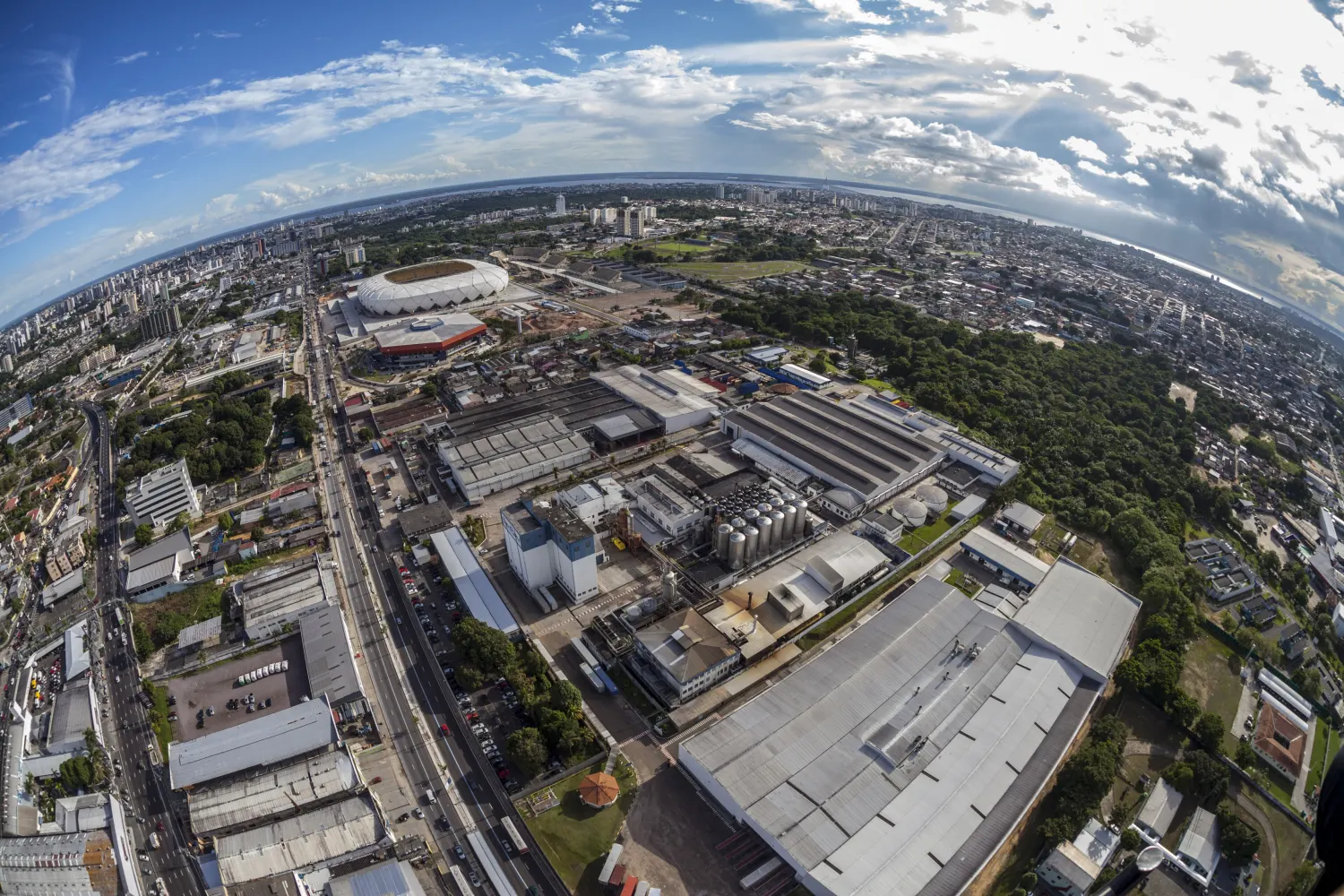
On 9 January 2026 a new Hedera account created a topic with the memo “Registro de emissões - MAINNET”, Portuguese for “emissions register”. Ten minutes later it posted its first record, 900 kg of bottled gas burned in a furnace at Yamaha Motor Componentes' factory in Manaus.
Ten months on, that topic holds more than 2,400 records from factories in Manaus, plus a contract that has started storing batches of them. Off-chain evidence shows that Ecodots, a software company based in Manaus, Brazil, is behind this, though it never mentions Hedera in its public-facing communications, only on its records verification page.
We also found no public statement that Ecodots is using Hedera from any of the usual sources, such as the Hedera Foundation or The Hashgraph Association. This looks like a newly discovered use case, and could be a case of organic adoption rather than grant-driven usage.
01Who is Ecodots?
Ecodots (Ecodots Tecnologia da Informação LTDA) sells environmental-compliance software from Manaus, the industrial capital of the Brazilian Amazon. Its platform covers:
- Greenhouse-gas inventories: a company's yearly emissions, split by scope, with the source, emission factor and formula kept for every number.
- Waste records and legal requirements.
- PMOC: the maintenance plan Brazilian law requires for air-conditioning systems, which also tracks refrigerant gas, a potent greenhouse gas when it leaks.
The clients on its homepage include Salcomp, Visteon, Givaudan, Fujifilm do Brasil and Caixa Econômica Federal. It also runs a public register where two clients, Salcomp and Visteon, have published their 2025 inventories.
We found no public announcement that Ecodots uses Hedera. Its homepage, about, platform, GHG and public-register pages don't mention Hedera or blockchain. Hedera's ecosystem page and The Hashgraph Association's site don't mention Ecodots, and nor does anything we found by searching the web. There's one place Hedera does appear prominently though, inside Ecodots' product. Each emission has a verification page that says “Blockchain Hedera Hashgraph” and links to HashScan, but you only reach it with that emission's link.
02How we know it's Ecodots
The topic never says “Ecodots” in its memo, but the evidence on and off the chain all points the same way.
1. Ecodots' verification pages name the topic
Every emission has a page on Ecodots' site, at ecodots.com.br/verificar-emissao/ followed by the emission's ID, and that ID is in the emission's record on the topic, so the chain itself leads you to the page. Each page shows “Hedera Mainnet”, topic ID 0.0.10223163, the message number and the record's fingerprints, and those fingerprints match the message on-chain. For example, message 4341 carries the ID e056776e-6a77-4d8d-b69f-4952a46b133f, which opens its page, reading “Registro verificado” (record verified). The check works the other way too. The page for message 1 shows “Divergência detectada”: the record was edited after it went on-chain, and the page says so.
Figure 1 · Ecodots' verification page, message 4341
Ecodots checks its own records against Hedera
- Verified Record. The record in Ecodots' system still matches the fingerprint it wrote to Hedera.
- Emission data. What the record is: here, 0.1 t of CO₂e from fuel burned on site in February 2025.
- Blockchain proof. Where to find it: topic 0.0.10223163, message 4341. The fingerprints in that message are the ones the page shows.
2. Ecodots' own registration number is on-chain
Message 776 records a document whose file name contains 41129755000178. That is Ecodots' CNPJ, its Brazilian company registration number: the footer of Ecodots' own website gives it as 41.129.755/0001-78, the same digits with added formatting.
3. A token named after Ecodots shares an operator with the topic
Every message on the topic is written by a register account, 0.0.10223014. A separate owner account, 0.0.10418559, deployed a set of contracts and created a token called “Ecodots CDF Certificate”. On 3 April its fingerprint contract, 0.0.10418600, turned away the register account with “not authorized”. Minutes later the owner approved it, and the register account's next try worked. The two accounts are run by one operator.
4. Salcomp's public inventory matches the chain to the day
Salcomp, a client on Ecodots' homepage, is the largest company on the topic (more on it below). On Ecodots' public register, Salcomp's 2025 inventory was verified by SGS do Brasil on 29 May 2026 and published on 1 October 2026. On the topic, Salcomp's emission records carry the organisation ID 69db1041 (see message 797), and that same ID has two ISO 14064 reports for 2025, in message 3537 and message 3538. ISO 14064 is the standard for greenhouse-gas inventories. The second report was written at 18:24 UTC on 1 October, the day of publication. Each report's fingerprint went into the contract within minutes.
03What Ecodots puts on Hedera
Everything runs through two accounts. A register account writes records to the emissions topic, and an owner account deployed Ecodots' contracts and created a token in April.
-
Account Register account 0.0.10223014
Writes every message on the topic and pays for it. Created 9 January 2026.
-
Topic Emissions register 0.0.10223163
“Registro de emissões - MAINNET”. 4,575 messages, which make 2,418 records once long records split across several messages are put back together.
-
Account Owner account 0.0.10418559
Deployed eight contracts on 3 April 2026 and owns the token below.
-
Contract Fingerprint contract 0.0.10418600
Stores fingerprints of batches of records. The only one of the eight contracts in use.
-
Token Ecodots CDF Certificate 0.0.10419214
An NFT for waste-disposal certificates under Brazil's national waste policy. None minted yet.
The records have changed over the year, in three steps you can see in Figure 2:
- January to early June: full records. Each emission went on-chain in full, with the client's name, the factory, the fuel or electricity, the quantity, the emission factor and the result. These are the 647 records we can read.
- From June: fingerprints only. On 2 June Ecodots switched to writing just a fingerprint of each record. A fingerprint (a hash) proves the record hasn't changed, without showing what's in it. 1,514 emission records have been written this way.
- October: air-conditioning, and more clients. Ecodots added PMOC records: refrigerant cylinders and air-conditioning equipment, 238 so far. At least three organisations that hadn't appeared before are on the topic in October. The records identify them only by ID numbers.
On the afternoon of 3 November the topic went quiet, and the fingerprint contract became busy. It stored 88 batch fingerprints in the next nine hours, about ten an hour, compared with 13 in the seven months before. Most batches cover five records. It's too early to tell whether the contract is replacing the topic.
Figure 2 · Topic 0.0.10223163 and contract 0.0.10418600
Ecodots' use of Hedera has changed over time
- Emissions, readable
- Emissions, fingerprint only
- Air-con (PMOC)
- Documents and reports
- Contract batches
A record is one logical message: records split over several messages are counted once. *November is to the end of the 3rd (UTC).
Show the data
Put together, Ecodots had written 2,519 records to Hedera by the end of 3 November, made up of 2,418 records on the topic and 101 batches in its contract. Only 647 of them, the full emission records from January to early June, show what was actually emitted, that's about a quarter (26%). Almost everything else is a fingerprint, 1,515 emission records, 232 air-conditioning records and the 101 contract batches prove that a record exists and hasn't changed, but not what's in it. So the clients and tonnes in the next section come from roughly a quarter of what Ecodots has put on-chain.
04Whose emissions?
The 647 readable records name four manufacturers in Manaus. All four are in the city's industrial zone, the Polo Industrial de Manaus:
- Salcomp, the biggest client on-chain, with 348 emissions, most of them industrial-process emissions for the second quarter of 2026.
- D.D. Williamson, a maker of caramel colouring. Its records are mostly fuel burned on site.
- Yamaha Motor Componentes, whose first record was the topic's first message.
- Impressora Amazonense, a printing firm, with fuel for its vehicles.
Together these records add up to about 3,463 tonnes of CO₂e. That's only part of the picture. The readable records are the ones from before June, and many cover a single quarter. Since then, more than 1,400 emissions have gone on-chain as fingerprints only.
The company on Hedera is Salcomp's Brazilian factory, Salcomp Industrial Eletrônica da Amazônia in Manaus. Its emissions are on Ecodots' register, and so is the fingerprint of its 2025 inventory, which was checked by SGS. So part of the climate reporting of one of the phone industry’s biggest suppliers is anchored on Hedera.
Figure 3 · Readable emission records, January to June 2026
Readable records document four clients and 3,500 tonnes of CO₂e
- Scope 1 (burned or released on site)
- Scope 2 (electricity)
Tonnes are each record's own total. Records written more than once are counted once. These are partial figures, not any company's full inventory.
Show the data
05What it means for Hedera
In fees, not much yet. In ten months Ecodots has paid about 140 HBAR, roughly US$12. Most of that went on deploying its contracts in April. The 4,575 topic messages cost about 36 HBAR in total.
The real signal is the kind of use. A local company with no announced link to Hedera picked it to make its clients' emissions data tamper-evident, and kept building on it:
- Real companies' compliance data. These are the greenhouse-gas inventories of multinational manufacturers' Brazilian plants.
- Strong signs of growth. New record types and new clients arrived in October, and the contract started batching on 3 November. Ecodots' other contracts, named for waste tracking, compliance checks and certificates, were set up in April but haven't been used yet, which suggests more is planned.
It's encouraging to see what appears to be Ecodots' organic adoption of Hedera – grant usage is great, but I think organic growth is more meaningful and what we're all hoping to see much more of.
While it's true that the network revenue generated by this use case is small, as it often is for these kinds of use cases, this usage signals that companies like Ecodots believe Hedera can add value for themselves and their customers.
Get the next deep dive
Get an email when we publish new research on the real-world businesses running on Hedera. Or follow along on X.
06Verify our research yourself
On Hedera
- Emissions register: topic 0.0.10223163
- Sample messages: message 1 (first record, Yamaha Motor Componentes; long records continue in the next message), message 776 (Ecodots' CNPJ in a file name), message 2824 (a fingerprint-only record), message 3538 (Salcomp's 2025 ISO 14064 report, 1 Oct)
- Register account: 0.0.10223014
- Owner account: 0.0.10418559
- Fingerprint contract: 0.0.10418600
- Ecodots CDF Certificate token: 0.0.10419214
Off-chain sources
- Ecodots: homepage and client list
- Ecodots: about page, with its company name and CNPJ in the footer
- Ecodots public register: Salcomp's 2025 inventory
- Ecodots verification pages: message 4341 (verified), message 1 (edited after it went on-chain)
While we try our best to ensure the accuracy of our information, please note that neither Ecodots nor its clients have publicly announced the use of Hedera, as far as we could find. We checked Ecodots' website, the Hedera Foundation's site, Hedera's ecosystem page, The Hashgraph Association's site and web searches. We also searched popular social media platforms, including X, LinkedIn and Reddit. The identification rests on Ecodots' own verification pages and the on-chain data.
Sources and method
Every on-chain figure comes from Hedera mainnet via the public mirror node, up to the end of 3 November 2026 (UTC). Records are the messages on topic 0.0.10223163 with multi-part messages put back together, plus the batch calls to contract 0.0.10418600. Tonnes of CO₂e are the totals each readable record states. Records written more than once are counted once, and the one record with no company name is left out. Fees are everything paid by accounts 0.0.10223014 and 0.0.10418559, including the owner's contract calls sent through a relay. Each month's fees are converted at the network's exchange rate in the middle of that month.
Photo: Portal da Copa, via Wikimedia Commons, CC BY 3.0 BR. This report is independent research and is not investment advice.